Monday, December 12, 2016

Top Analytics, Data Science software


R, Python Duel As Top Analytics, Data Science software – KDnuggets 2016 Software Poll Results

R remains the leading tool, with 49% share, but Python grows faster and almost catches up to R. RapidMiner remains the most popular general Data Science platform. Big Data tools used by almost 40%, and Deep Learning usage doubles.  

The poll got tremendous participation from analytics and data science community and vendors, attracting 2,895 voters, who chose from a record number of 102 different tools.

R remains the leading tool, with 49% share (up from 46.9% in 2015), but Python usage grew faster and it almost caught up to R with 45.8% share (up from 30.3%). RapidMiner remains the most popular general platform for data mining/data science, with about 33% share. Notable tools with the most growth in popularity include Dato, Dataiku, MLlib, H2O, Amazon Machine Learning, scikit-learn, and IBM Watson.

The increased choice of tools is reflected in wider usage. The average number of tools used was 6.0, vs 4.8 in 2015.

The usage of Hadoop/Big Data tools grew to 39%, up from 29% in 2015 (and 17% in 2014), driven by Apache Spark, MLlib (Spark Machine Learning Library) and H2O.
The participation by region was: US/Canada (40%), Europe (39%), Asia (9.4%), Latin America (5.8%), Africa/MidEast (2.9%), Australia/NZ (2.2%).

Top Analytics/Data Science Tools

Next table has the top 10 most popular tools in 2016 poll
Tool2016
% share
% change% alone
R49%+4.5% 1.4%
Python45.8%+51% 0.1%
SQL35.5%+15% 0%
Excel33.6%+47% 0.2%
RapidMiner32.6%+3.5% 11.7%
Hadoop22.1%+20% 0%
Spark21.6%+91% 0.2%
Tableau18.5%+49% 0.2%
KNIME18.0%-10%4.4%
scikit-learn17.2%+107% 0%

In this table 2016 % share is % of voters who used this tool, % change is the change in share vs 2015 poll, and % alone is the percent of voters who used only the reported tool among all voters who used that tool. E.g. 4.4% of KNIME voters reported using only KNIME and nothing else. We note a decrease in such lone voting, with only 9 tools having 5% or more lone votes.

Top10 Analytics Data Science Software 2016
Fig 1: KDnuggets Analytics/Data Science 2016 Software Poll: top 10 most popular tools in 2016

Compared to 2015 KDnuggets Analytics/Data Science Poll results, the only newcomer in top 10 was scikit-learn, displacing SAS.

Tools with the highest growth (among tools with at least 15 users in 2015) were
Tool% change2016 %share2015 %share
Dato377%2.4%0.5%
Dataiku292%7.8%2.0%
MLlib253%11.6%3.3%
H2O233%6.7%2.0%
Amazon Machine Learning171%1.9%0.7%
scikit-learn107%17.2%8.3%
IBM Watson99%4.2%2.1%
Splunk/ Hunk98%2.2%1.1%
Spark91%21.6%11.3%
Scala79%6.2%3.5%


This year, 86% of voters used commercial software and 75% used free software. About 25% used only commercial software, and 13% used only open source/free software. A majority of 61% used both free and commercial software, similar to 64% in 2015.

New (in this poll) tools that received at least 1% share votes in 2016 were
  • Anaconda, 16%
  • Microsoft other ML/Data Science tools, 1.6%
  • SAP HANA, 1.2%
  • XLMiner, 1.2%
Among tools with at least 15 votes in 2015, the largest decline in 2016 was for the tools below, which includes probably a combination of decline of popularity for free tools like F# and lack of a voter drive for some of commercial tools this year.
  • Ayasdi, down 85%, to 0.3% share from 2.0%
  • Actian, down 83%, to 0.3% share from 2.0%
  • Datameer, down 52%, to 0.4% share from 0.9%
  • SAP Analytics, down 51%, to 1.5% share from 3.0%
  • SAS Enterprise Miner, down 49%, to 5.6% from 10.9%
  • Alteryx, down 46%, to 3.0% share from 5.6%
  • F#, down 42%, to 0.4% share from 0.7%
  • TIBCO Spotfire, down 36%, to 2.8% share from 4.3%
  • JMP, down 36%, to 2.0% share from 3.1%

Hadoop/Big Data Tools

The usage of Hadoop/Big Data tools grew to 39%, up from 29% in 2015 and 17% in 2014), driven mainly by big growth in Apache Spark, MLlib (Spark Machine Learning Library) and H2O, which we included among Big Data tools.

Here are the Big Data tools and their share in 2016, 2015, and %change.
Tool2016
%Share
2015
%share
% change
Hadoop22.1%18.4%+20.5%
Spark21.6%11.3%+91%
Hive12.4%10.2%+21.3%
MLlib11.6%3.3%+253%
SQL on Hadoop tools7.3%7.2%+1.6%
H2O6.7%2.0%+234%
HBase5.5%4.6%+18.6%
Apache Pig4.6%5.4%-16.1%
Apache Mahout2.6%2.8%-7.2%
Dato2.4%0.5%+338%
Datameer0.4%0.9%-52.3%
Other Hadoop/HDFS-based tools4.9%4.5%+7.5%

Deep Learning Tools

For the second year KDnuggets poll include Deep Learning Tools. This year, 18% of voters used Deep Learning tools, doubling the 9% in 2015.

Google Tensorflow jumped to first place, displacing last year leader Theano/Pylearn2 ecosystem.

Top tools:
  • Tensorflow, 6.8%
  • Theano ecosystem (including Pylearn2), 5.1%
  • Caffe, 2.3%
  • MATLAB Deep Learning Toolbox, 2.0%
  • Deeplearning4j, 1.7%
  • Torch, 1.0%
  • Microsoft CNTK, 0.9%
  • Cuda-convnet, 0.8%
  • mxnet, 0.6%
  • Convnet.js, 0.3%
  • darch, 0.1%
  • Nervana, 0.1%
  • Veles, 0.1%
  • Other Deep Learning Tools, 3.7%
The Deep Learning field is still in the beginning of its journey, as we see by the large number of options.

Programming Languages

Python, Java, Unix tools, Scala grew in popularity, while C/C++, Perl, Julia, F#, Clojure, and Lisp declined.

Here are the programming languages sorted by popularity.
  • Python, 45.8% share (was 30.3%), 51% increase
  • Java, 16.8% share (was 14.1%), 19% increase
  • Unix shell/awk/gawk 10.4% share (was 8.0%), 30% increase
  • C/C++, 7.3% share (was 9.4%), 23% decrease
  • Other programming/data languages, 6.8% share (was 5.1%), 34.1% increase
  • Scala, 6.2% share (was 3.5%), 79% increase
  • Perl, 2.3% share (was 2.9%), 19% decrease
  • Julia, 1.1% share (was 1.1%), 1.6% decrease
  • F#, 0.4% share (was 0.7%), 41.8% decrease
  • Clojure, 0.4% share (was 0.5%), 19.4% decrease
  • Lisp, 0.2% share (was 0.4%), 33.3% decrease

Wednesday, November 16, 2016

6 steps to take your research from idea to action


Open Access Week exclusive cartoon

Open Access Week 2016 is here, a global event that promotes Open Access (OA) in scholarship and research. This year’s theme is ‘Open in Action’, so we’re taking a look at the potential OA research has to be ‘actioned’ by groups outside of academia (browse our OA Week article collection, showcasing how research addresses vital issues).

The benefits of OA: what you told us

Our 2014 Open Access Survey results showed that a significant number of researchers agreed with the following:
50% thought OA could lead to a larger readership for their published research.
65% believed publishing OA offered greater visibility for their work.
81% felt their work could have a wider circulation if it was published OA.

Want to know more? Check out the key findings infographic and browse the full results.

Open Access: from research to action

So what do you need to consider if you would like your research to be picked up and actioned by practitioners, policy makers, NGOS, clinicians, the media or anyone else? In honor of OA Week we’ve put together this exclusive cartoon, that outlines some of the steps you should consider (and is summarised below).
1. Who do you want to read your research? Be clear from your first draft who the key audience for your published research is.
2. Think about that audience when you’re choosing a journal to publish your research in. Find out more about a journal’s readership by reading the aims and scope and browsing published research article metrics.
3. Make your research discoverable, so spend time on your title, your abstract and your article keywords. Think about the words people will use to search for your work and include them.
4. Think about what else you can do to make your research accessible, including whether to enhance your published work with supplemental material, including data.
6. Published? Tell others about it and get in touch so we can help you spread the word (more on the role of marketing in OA).

Saturday, November 12, 2016

IoT Landscape 2016


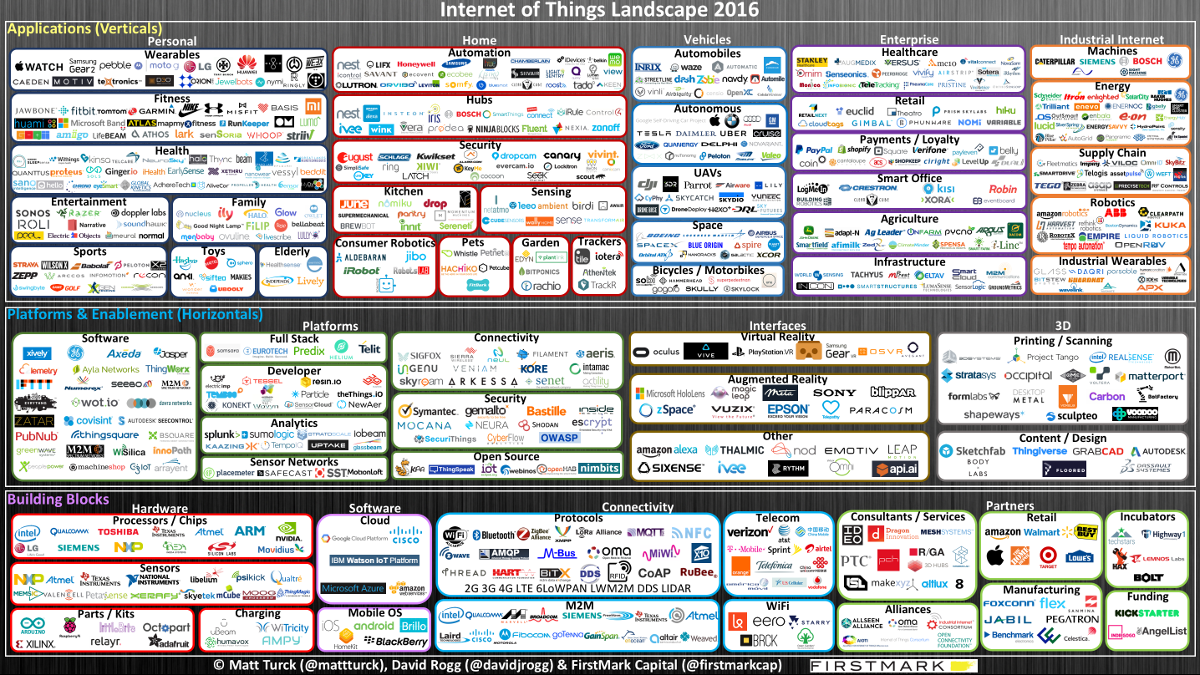
For now, with startup creation and funding in full swing, we can barely keep track of all new IoT startups appearing on the market.  Certain areas, particularly on the consumer IoT side (most blatantly, wearables, fitness and home automation) are now overcrowded, inevitably raising the specter of failure and forced consolidation.  The enterprise and industrial sides of the Internet of Things are more open, bearing in mind that some existing players in those spaces have been operating for decades.
Here’s our 2016 landscape:
Internet-of-Things-2016_sm
As in previous versions, the chart is organized into building blocks, horizontals and verticals. Pretty much every segment is seeing a lot of activity, but it is worth noting that those parts are not particularly well integrated just yet, meaning in particular that vertical applications are not necessarily built on top of horizontals. To the contrary, we’re very much very much in the era of the “full stack” IoT startup – because there is no dominant horizontal platform, and not enough mature, cheap and fully reliable components just yet, startups tend to build a lot themselves: hardware, software, data/analytics, etc. Some enterprise IoT companies, such as our portfolio company Helium, also have a professional services organization on top, as enterprise customers are at the stage where they try to make sense of the IoT opportunity and are looking for something that “just works”, as opposed to mixing and matching best of breed components. This is a typical characteristic of startups operating in an early market, and I would expect many of those companies to evolve over time, and possibly ditch the hardware component of their business entirely.
Dancing with the giants
To fully make sense the IoT ecosystem, it’s important to fully realize that large corporations are omnipresent in it. I mentioned this in an earlier post about home automation, but a glance through the 2016 IoT landscape will quickly establish that they are active in pretty much every single category.
In the Internet era (90s and 00s), the dynamic was brutal but pretty simple (at least in retrospect) – on one side, there were the disruptors (Internet-native startups with no legacy); on the other side there were the disrupted (bricks and mortars and other large incumbents paralyzed by the innovator’s dilemma). In the IoT era, things are a little trickier – some of the startups of the Internet era have grown up to be large companies themselves, for example, and it is less clear who is best equipped to disrupt who.
Large public tech and telecom companies have been all over the IoT, which they rightly regard as something that will truly move the needle for them over the next few years and possibly decades. It is entirely possible that, in some cases, announcements are ahead of reality, but nonetheless the trend is clear. Chipmakers (Intel, Qualcomm, ARM) are racing to dominate the IoT chip market. Cisco has been incredibly vocal about the “Internet of Everything” and walked the talk with the $1.4bn Jasper acquisition a few weeks ago. IBM announced a $3 billion investment in a new IoT business unit. AT&T has been aggressive in being the connectivity layer for cars, partnering with 8 out 10 top US car manufacturers. Many telecom companies view their upcoming 5G networks as the backbone of the IoT. Apple, Microsoft and Samsung have been very active across the ecosystem, offering both hubs/platforms (Homekit for Apple, SmartThings and an upcoming OS for Samsung, and Azure IoT for Microsoft) and end products (Apple Watch for Apple, Gear VR and plenty of connected appliances for Samsung and the upcoming HoloLens AR headset for Microsoft). Salesforce announced an IoT cloud a few months ago. The list goes on and on.
Alphabet/Google and Amazon are probably worth mentioning separately because of the magnitude of their potential impact.   From Nest (home) to SideWalk Labs (smart cities) to autonomous cars to the Google Cloud, Alphabet already covers huge portions of the ecosystem, and has invested billions in it. On Amazon’s end, AWS seems to be an ever increasing force that keeps innovating and launching new products, including a new IoT platform this year which it inevitably push aggressively to become the backend for the IoT; in addition, the company’s eCommerce operations are increasingly important to IoT products distribution, and Echo/Alexa is turning out to be a major sleeper hit for the company in the home automation world. Both Alphabet and Amazon very much move at the speed of the startups they were not so long ago, sit on immense amounts of user data, and have limitless access to top talent.
Outside the technology world, many “traditional” corporate giants (industrial, manufacturing, insurance, energy, etc.) have both a lot to gain and lot to fear from the Internet of Things.   This is a perhaps unprecedented opportunity to rethink just about everything.   The IoT will essentially enable (or perhaps, force) large companies to evolve from a product-centric model to a service-centric model. In an IoT-enabled world, large companies will have direct knowledge about how their customers actually use their products; they will be able to market and customize their offerings to a variety of needs (through the software); they will be able to predict when the product will fail and may need support; and they’ll have an opportunity to charge customers by usage (as opposed to a one-time purchase cost), opening the door to subscription models and direct long-term relationships with customers.   The impact of those changes on supply chain and retail is likely to be enormous. On the other hand, the threat is immense – what happens to the car industry, for example, as autonomous vehicles become a reality powered by software developed by Google, Apple, Baidu or Uber? Will they be relegated to the status of part maker?
The opportunity to thrive in an IoT world hinges largely on those companies’ ability to gradually evolve into software companies, an immensely difficult cultural and organizational transformation. Some traditional industry companies already have software arms – see Bosch Software Innovations for example or this piece about how General Electric recruited hundreds of software developers in its new Silicon Valley tech offices – so this is not an impossible task, but many companies will struggle immensely to do so.
What does this all mean for startups? Of course, the interest from large companies opens the door to all sorts of acquisition opportunities, both small and large, and sometimes for amounts that are largely disconnected from existing traction (see Nest, Oculus or Cruise) – large tech companies have already demonstrated their acquisition appetite, and large traditional companies will most likely need to acquire their way into becoming software companies.   On the other hand, for new startups intending to stay the course and become large independent companies, the path will occasionally be fairly narrow and will require astute maneuvering.   Larger companies (e.g. Alphabet/Nest) will certainly not build every single connected product (e.g., every home automation device), but at the same time they will likely preempt the larger opportunities in the space (e.g. being the home automation platform). Or occasionally they will be incredibly aggressive in pursuing the best talent in the market – let’s remember how a few months ago, Uber poached 40 robotics researchers from Carnegie Mellon to help fuel its self-driving technology ambitions. For young startups, the successful strategy will probably involve a combination of finding the right tip of the spear away from the more crowded areas of the market, and partnering with the right large corporate giants to have access to their manufacturing and distribution networks.
Conclusion
The Internet of Things is coming.  Obstacles abound, but as our landscape shows, there is an immense amount of activity happening worldwide from both startups and large companies that make this conclusion all but inevitable. Progress may seem slow in some ways, but in fact it is happening remarkably quickly when one pauses to think about the magnitude of the change a fully connected world requires. What seemed like complete science fiction 10 years ago is in the process of becoming reality, and we are getting very close to being surrounded by connected objects, drones and autonomous cars. The bigger question might be whether we are ready as a society for this level of change.